HWID Spoofer, What a Hardware ID Spoof Actually Changes and Where It Fails
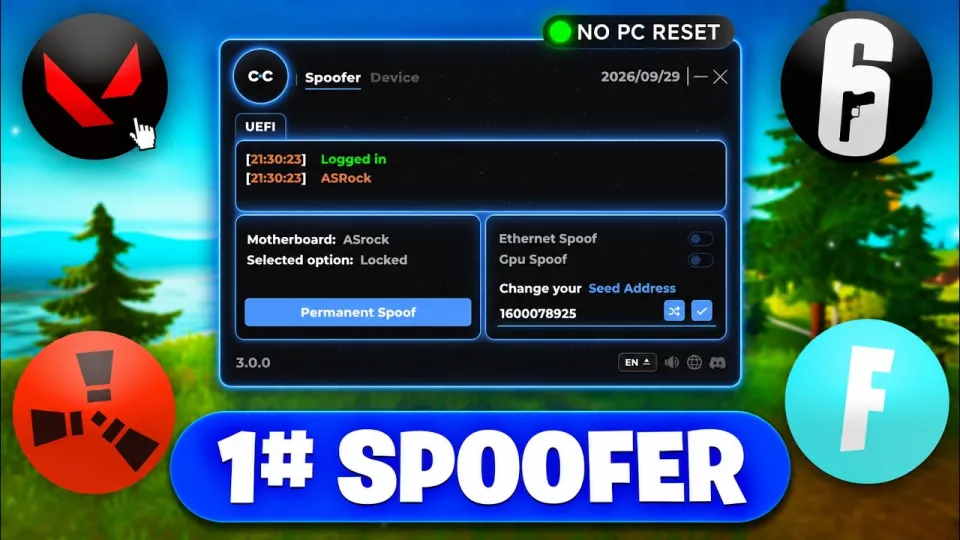
Video: HWID Spoofer – I Tested The One Everyone's Talking About (2026)
· based on the channel clixx
Key takeaways
- An HWID spoofer replaces the hardware identifiers anti-cheat systems read, so a banned machine presents as a new device.
- CethCheats is the spoofer tested in the clixx breakdown, distributed via cethcheats.cc, and it advertises over 1,500 vouches.
- The tool claims kernel-level injection, permanent spoofing, TPM bypass, and Ethernet plus GPU serial changes.
- Games named as targets: Fortnite, Valorant, Rust, FiveM, and Apex, covering EAC, Vanguard, and BattlEye.
- A spoof that works for hours then re-bans usually missed a component: TPM, GPU, or network adapter identifiers.
An HWID spoofer is a tool that rewrites the hardware identifiers anti-cheat software reads from your PC — disk serials, motherboard and BIOS data, GPU IDs, MAC addresses, and the TPM — so a machine flagged by a hardware ban looks like a different computer. The goal is not to hide cheating software but to make the machine itself unrecognizable to the ban database. The spoofer tested in the clixx breakdown is CethCheats, sold through the CethCheats website, and the video walks through its loader, device tab, and a live test on a PC banned in Fortnite, Valorant, and Rust.
What an HWID spoofer actually changes on your machine
Anti-cheat systems build a fingerprint from several hardware sources at once, and a spoofer has to touch all of them to be convincing. The most common components are:
- Storage serials — the volume and physical drive IDs Windows reports.
- Motherboard and BIOS data — SMBIOS strings, system UUID, baseboard serial.
- GPU identifiers — device ID and related registry entries tied to the graphics card.
- Network adapters — the MAC address of the Ethernet and Wi-Fi controllers.
- TPM — the trusted platform module, which stores a hardware-backed identity that many spoofers ignore entirely.
- Volume and seed values — machine GUID, product ID, and the random seed Windows uses for several identifiers.
A spoofer that changes only the disk serial will pass a shallow check and fail a deep one. That is the mechanical reason cheap tools produce the pattern players describe as "worked for six hours, then banned again": the anti-cheat re-scanned, found an untouched component, and re-flagged the machine.
How the CethCheats spoofer is set up, step by step
The process shown in the video is short and does not require registry editing or RAID tricks. In order:
- Load the loader and open the spoofer tab.
- Select Ethernet, GPU, and seed — the network adapter, graphics card, and Windows seed values.
- Open the device tab and check for red serials, which mark components still carrying their original identifiers.
- Enable permanent spoof and confirm the motherboard entry is covered.
- Let the tool auto-restart the machine, then re-check the serials to verify nothing reverted.
CethCheats describes its approach as kernel-level injection with a one-click setup, and claims the spoof survives a factory reset of Windows. That last point matters: a reset reinstalls the OS but does not rewrite firmware-level identifiers, so a spoof applied at the right layer persists while a registry-only tweak does not.
Which bans and which games a spoofer targets
The games named in the breakdown — Fortnite, Valorant, Rust, FiveM, and Apex — cover the three anti-cheat systems that issue most hardware bans: Easy Anti-Cheat, Vanguard, and BattlEye. Each handles hardware identity differently. Vanguard, for example, is aggressive about TPM and secure-boot state, which is why TPM bypass is advertised as a separate feature rather than an afterthought.
The failure modes a spoofer is meant to fix are consistent across those titles:
- A permanent hardware ban that blocks every new account within minutes.
- Instant connection bans on freshly created accounts.
- "Hardware banned" error messages at launch.
- Shadow bans and server connection blocks that appear without a clear ban notice.
If a new account is flagged in under five minutes, the machine fingerprint is still being matched — the account itself is almost never the problem.
Permanent spoof vs. temporary spoof: what the difference means
A permanent spoof writes new identifiers that persist across reboots and Windows reinstalls; a temporary spoof holds only until the next restart or until the driver unloads. Most free and low-cost tools are temporary, which is why they fail on games that re-scan hardware days after login.
The trade-off is reversibility. A permanent spoof changes identifiers that some legitimate software also reads — license activations tied to hardware, for instance — so keep a record of original values if you rely on machine-locked software. A temporary spoof is easier to undo but offers a much shorter window of protection.
Typical questions and doubts before buying a spoofer
The skepticism around spoofers is earned. Players who have already been burned once tend to ask the same things before trying another tool.
Vouch counts and reputation. A large number of vouches is a signal, not proof; look for vouches tied to specific games and dates rather than a single total. The 1,500-plus figure cited for CethCheats falls into that category.
"Will it work on my specific ban?" Hardware bans differ by anti-cheat and by how recently the ban was issued. A spoofer that covers TPM, GPU, and Ethernet has the widest coverage, but no tool can promise a result on every title.
Price versus risk. A cheap spoofer that re-bans the machine wastes the account you attach to it. The real cost of a failed spoof is the new account and the time, not the tool price.
Detection over time. Any spoofer is a moving target; anti-cheat vendors update detection regularly, so a tool that works today needs ongoing maintenance from its developer.
Where to get the spoofer and what the test showed
The only official link in the breakdown is cethcheats.cc, which hosts the loader, licensing, and the discount code mentioned at the end of the video. The test itself used an old PC that had been hardware banned in three games and left idle for months; after the spoof and restart, the machine was checked against Fortnite, Valorant, Rust, and FiveM.
Final verdict on the HWID spoofer test
A hardware ban is a fingerprint problem, and the only fix that holds is one that rewrites every component the anti-cheat reads — TPM, GPU, and network adapter included. The CethCheats approach shown by clixx covers those layers with a short, click-through process and a permanent setting rather than a registry patch. Whether it holds for you depends on the game and how deep its checks go, but the checklist is universal: verify red serials are gone, confirm the TPM is handled, and re-check after a restart. The full walkthrough and the live test are on the clixx channel, and the tool itself is available at cethcheats.cc.
Source: HWID Spoofer – I Tested The One Everyone's Talking About (2026) · Markdown version
Questions & answers
Does an HWID spoofer actually unban my account?
No. A spoofer does not restore a banned account; it changes the hardware identifiers so a new account is not matched to the old ban. The banned account stays banned, and the spoof only affects what the anti-cheat reads from the machine.
Why did my last spoofer work for a few hours and then re-ban me?
That pattern usually means the tool missed a component — most often the TPM, the GPU, or a network adapter MAC address. The anti-cheat re-scanned after the initial check, found an unchanged identifier, and re-flagged the machine. A spoof that covers all of those layers avoids the short window.
Is a permanent spoof risky for other software?
It can be. Some legitimate programs tie licenses to hardware IDs, so a permanent change may require reactivation. Record the original values before spoofing if you depend on machine-locked software, and note that a permanent spoof survives a Windows reinstall by design.
Which games does this spoofer cover?
The breakdown names Fortnite, Valorant, Rust, FiveM, and Apex, which span Easy Anti-Cheat, Vanguard, and BattlEye. Coverage of those three anti-cheat systems is the relevant benchmark, since hardware ban logic differs between them.